


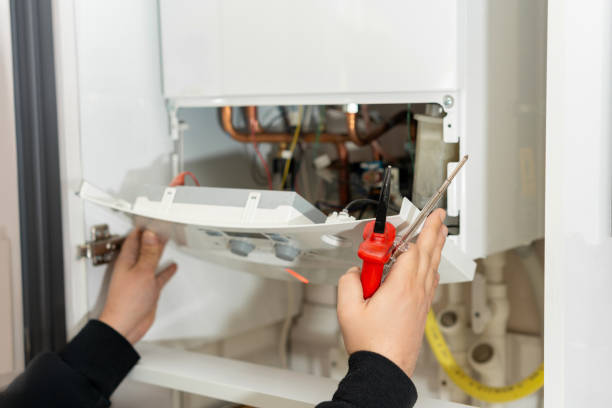
A boiler does not always need replacing when it develops a fault. In many cases, repairing a faulty component can restore normal operation without the expense of installing a new boiler. However, if your boiler keeps breaking down, struggles to heat your home, develops major internal faults, or becomes expensive to maintain, replacement may be the better long-term option.
The decision usually depends on the boiler’s age, repair costs, energy efficiency, reliability, and overall condition.
For homeowners, the important thing is to recognise the warning signs before a minor fault turns into a major heating problem. Here is how to decide whether your boiler needs a repair or a complete replacement.
Boiler Repair vs Replacement: What Is the Difference?
Boiler repair means fixing or replacing a faulty component in your existing heating system. Boiler replacement means removing the old unit and installing a new boiler.
| Boiler repair | Boiler replacement |
|---|---|
| Fixes a specific fault | Replaces the entire boiler |
| Usually costs less initially | Requires a higher upfront investment |
| Suitable for many minor and moderate faults | Suitable for ageing or seriously damaged boilers |
| Keeps your existing boiler | Provides a new heating appliance |
| May be completed relatively quickly | Usually requires more installation work |
| Does not necessarily improve overall efficiency | May improve efficiency compared with an older boiler |
A repair is often sensible when the boiler is in good condition and the problem is limited to one replaceable component.
Replacement becomes more attractive when the boiler has several faults, repeated breakdowns, poor efficiency, or a major component failure.
10 Signs Your Boiler Needs Repair or Replacement
Understanding the warning signs can help you make a better decision.
1. Your Boiler Keeps Breaking Down
Frequent boiler breakdowns are one of the clearest signs that your heating system needs professional attention.
An occasional fault does not necessarily mean you need a new boiler. However, repeated problems may indicate that several components are wearing out.
Common issues include:
- Repeated ignition failures.
- Boiler pressure problems.
- Frequent error codes.
- Unusual noises.
- Heating interruptions.
- Hot water stopping unexpectedly.
If the same fault keeps returning after repairs, ask an engineer to investigate the underlying cause.
Repair or replacement?
If the problem involves one faulty component, a repair may be sufficient. If several components are failing and breakdowns are becoming more frequent, replacement may offer better long-term value.
2. Your Boiler Is More Than 10–15 Years Old
Boiler age is another important factor when deciding whether to repair or replace it.
Many modern boilers have an expected working life of around 10–15 years, although actual lifespan depends on the model, installation quality, servicing, and usage.
An older boiler may experience:
- More frequent component failures.
- Reduced heating efficiency.
- Difficulty finding replacement parts.
- Higher maintenance requirements.
- Inconsistent heating performance.
However, age alone does not mean a boiler must be replaced. A well-maintained older boiler may still operate safely and reliably.
Repair or replacement?
If an older boiler develops a minor fault and replacement parts are readily available, repairing it may still make sense.
If it is approaching the end of its expected service life and requires expensive repairs, comparing replacement costs is worthwhile.
3. Your Energy Bills Keep Increasing
A sudden or gradual increase in energy bills can sometimes indicate that your boiler is not operating efficiently.
As boilers age, certain components may deteriorate, and heating performance can decline.
Possible signs include:
- Longer heating times.
- Radiators taking longer to warm up.
- The boiler running for extended periods.
- Higher energy consumption without a clear change in usage.
However, rising energy bills do not automatically mean the boiler is faulty. Energy prices, insulation, thermostat settings, and household usage also affect costs.
Repair or replacement?
If a faulty component is reducing efficiency, a repair may help.
If your boiler is old and significantly less efficient than modern alternatives, replacing it may reduce energy consumption. The actual savings depend on the new boiler, existing system, home insulation, and usage.
4. Your Boiler Makes Unusual Noises
Boilers normally produce some operating sounds, but loud or unusual noises can indicate a problem.
Listen for:
- Banging.
- Whistling.
- Gurgling.
- Humming.
- Vibrating.
- Kettling sounds.
A kettling noise may occur when mineral deposits or restricted water flow cause water to overheat inside the heat exchanger.
Other noises may come from air in the heating system, pump problems, pressure issues, or loose components.
Repair or replacement?
Many noise-related problems can be repaired. For example, trapped air or a faulty pump may be addressed without replacing the entire boiler.
However, severe heat exchanger damage or multiple internal faults may make replacement more practical.
Do not ignore persistent loud noises. Arrange a professional inspection to identify the cause.
5. Your Boiler Has Water Leaks
Water leaking from a boiler or heating system should never be ignored.
Leaks may develop around:
- Pipe connections.
- Pump seals.
- Pressure relief valves.
- Heat exchanger connections.
- Radiator valves.
- Internal boiler components.
Even a small leak can cause pressure loss and affect heating performance.
Repair or replacement?
A leaking connection or replaceable valve may require only a repair.
However, if the heat exchanger or another major internal component is damaged, the repair may be expensive. The engineer should compare the repair cost with the condition and remaining expected life of the boiler.
Never remove the boiler casing to investigate a leak yourself.
6. Your Boiler Struggles to Provide Heating or Hot Water
If your boiler cannot maintain comfortable heating or provide consistent hot water, it may have a fault.
You may notice:
- Radiators staying cold.
- Hot water changing temperature unexpectedly.
- Heating taking longer than usual.
- The boiler switching off unexpectedly.
- Hot water working intermittently.
Possible causes include a faulty pump, thermostat, diverter valve, heat exchanger, or other system components.
Sometimes the issue is not the boiler itself. A thermostat, heating control, or wider pipework problem may be responsible.
Repair or replacement?
If the issue comes from a repairable component, a professional repair may restore performance.
If the boiler has several major faults or cannot meet your household’s heating and hot-water needs, replacement may be worth considering.
7. Replacement Parts Are Difficult to Find
Finding replacement parts can become more difficult as a boiler gets older.
Some manufacturers discontinue older models, and certain components may become expensive or difficult to source.
This can increase repair time and make maintaining an ageing boiler less convenient.
Repair or replacement?
If the required part is available at a reasonable cost, repairing the boiler may still be practical.
If important components are no longer available or repairs are becoming increasingly expensive, a new boiler may be a better long-term solution.
Ask your heating engineer whether suitable manufacturer-approved replacement parts are available.
8. Your Boiler Pressure Keeps Dropping
A boiler that repeatedly loses pressure may have a leak or a faulty internal component.
Common causes include:
- Leaking radiators or pipework.
- A faulty expansion vessel.
- A damaged pressure relief valve.
- Internal boiler leaks.
- Recent radiator bleeding.
A small pressure adjustment after radiator bleeding can be normal. However, frequent pressure loss is not something to ignore.
Repair or replacement?
Most pressure-related problems do not automatically require a new boiler.
A leak, expansion vessel fault, or pressure relief valve problem may be repairable. Replacement should be considered only after the actual fault and overall boiler condition have been assessed.
Read our guide to common boiler pressure problems and their fixes for more information.
9. Your Boiler Needs Expensive Repairs
Repair costs are an important part of the replacement decision.
A relatively inexpensive repair may be sensible, even on an older boiler. However, spending a large amount on a boiler that has several other developing faults may not be worthwhile.
For example, if an older boiler needs a major component replaced and has already required several repairs, you should compare the total repair cost with the price of installing a new unit.
Consider:
- The current repair quotation.
- The age of the boiler.
- Its previous repair history.
- The availability of parts.
- Its overall condition.
- The expected cost of future maintenance.
Repair or replacement?
If the repair is affordable and the rest of the boiler is in good condition, repairing it may be the better option.
If major repairs are expensive and further breakdowns are likely, replacement may provide better long-term value.
10. Your Boiler Is No Longer Safe to Operate
Safety should always come before repair costs or convenience.
A boiler with a suspected gas leak, carbon monoxide problem, unsafe flue, or serious combustion fault requires immediate professional attention.
Warning signs may include:
- A smell of gas.
- A carbon monoxide alarm sounding.
- Soot or unusual staining around the appliance.
- Visible damage to the flue.
- Repeated safety-related shutdowns.
Repair or replacement?
A qualified gas engineer must assess the appliance and determine whether it can be made safe through repair.
If the boiler is beyond safe or economical repair, replacement may be necessary.
If you smell gas, do not operate electrical switches or use naked flames. Leave the area, follow the gas emergency procedure for your location, and contact the appropriate emergency service. If a carbon monoxide alarm sounds, move everyone into fresh air and seek emergency assistance.
When Is Repairing Your Boiler the Better Option?
Repairing your boiler is often the sensible choice when the fault is limited, the appliance is reasonably reliable, and replacement parts are available.
Consider repair when:
- Your boiler is relatively new.
- The problem involves one replaceable component.
- The repair cost is reasonable.
- The boiler has a good maintenance history.
- It provides sufficient heating and hot water.
- The engineer confirms that the appliance is safe to use.
For example, a boiler with a faulty thermostat or circulation pump may not need complete replacement if the rest of the system is in good condition.
A proper diagnosis can prevent unnecessary replacement expenses.
When Should You Replace Your Boiler?
Replacement may be the better choice when your existing boiler has reached the end of its useful life or requires repairs that are no longer economical.
Consider replacement when:
- Your boiler is old and frequently breaks down.
- Major internal components are damaged.
- Replacement parts are difficult to obtain.
- Repair costs are becoming excessive.
- Heating performance has deteriorated significantly.
- The appliance cannot be made safe.
- A newer system would better meet your household’s heating and hot-water requirements.
A new boiler may provide better efficiency, reliability, and control options, depending on the model and installation.
However, replacement is a significant investment. Ask for a professional assessment and a clear quotation before making a decision.
Boiler Repair vs Replacement: Cost Comparison
There is no single repair or replacement price that applies to every boiler. Costs vary according to the boiler model, fault, parts, labour, installation requirements, and location.
Use this table to understand the factors that can influence the decision.
| Factor | Repair | Replacement |
|---|---|---|
| Initial expense | Usually lower | Usually higher |
| Labour | Depends on the fault | Includes installation work |
| Parts | Specific faulty components | New boiler and required components |
| Installation changes | Usually limited | May involve pipework or flue changes |
| Long-term reliability | Depends on the boiler’s overall condition | A new appliance may offer more predictable operation |
| Energy efficiency | May improve if the fault affected performance | May improve if replacing an inefficient older model |
| Best suited for | Repairable faults | Ageing, unsafe, or uneconomical boilers |
The 50% Repair Rule: Is It Reliable?
Some homeowners use a simple rule: if the repair costs more than 50% of the price of a new boiler, replacement may be worth considering.
This can be a useful starting point, but it is not a universal industry rule.
A cheaper repair may still be poor value if the boiler is very old and has several other problems. Similarly, an expensive repair may be worthwhile if the boiler is relatively new and otherwise in excellent condition.
Always consider the boiler’s age, repair history, safety, and expected remaining service life alongside the quotation.
What to Check Before Buying a New Boiler
If you decide that replacement is the better option, do not choose a new boiler based only on its price.
Consider these factors before arranging installation.
1. Boiler Type
Common domestic boiler types include:
- Combi boiler: Provides heating and hot water without a separate hot-water storage cylinder.
- System boiler: Uses a separate hot-water cylinder but incorporates many heating components within the boiler.
- Regular boiler: Works with a separate hot-water cylinder and feed-and-expansion tank arrangement.
The suitable type depends on your property, existing heating system, hot-water demand, and available space.
2. Boiler Size and Output
The boiler must have enough output to meet your home’s heating and hot-water requirements.
An undersized boiler may struggle to meet demand, while an oversized boiler may cost more than necessary.
A qualified heating engineer should assess the property and calculate the appropriate boiler output.
3. Energy Efficiency
Compare the efficiency ratings and operating information of different models.
A modern condensing boiler can be more efficient than an older non-condensing model, although the actual improvement depends on the existing appliance and heating system.
4. Warranty and Manufacturer Support
Check the manufacturer’s warranty conditions, registration requirements, and servicing recommendations.
Also consider whether replacement parts and local technical support are readily available.
5. Installation Quality
Even a good boiler may perform poorly if it is installed incorrectly.
Use a suitably qualified and registered heating professional who can assess the existing pipework, controls, flue, and system condition.
Frequently Asked Questions About Boiler Repair and Replacement
How do I know if my boiler needs replacing?
Your boiler may need replacing if it is old, breaks down frequently, requires expensive repairs, or has serious internal damage. A qualified heating engineer should assess its condition before recommending replacement.
How many years should a boiler last?
Many modern boilers have an expected working life of around 10–15 years. However, servicing, installation quality, usage, water quality, and maintenance can affect how long a boiler lasts.
Is it worth repairing a 15-year-old boiler?
It depends on the fault and the boiler’s overall condition. A minor repair may still be worthwhile, but expensive repairs on an ageing boiler should be compared with the cost of replacement.
Is it cheaper to repair or replace a boiler?
Repairing is usually cheaper initially. However, replacing an old boiler may offer better long-term value if the existing appliance requires repeated or expensive repairs.
Can a boiler be too old to repair?
A boiler can become uneconomical or impractical to repair if parts are unavailable, major components have failed, or the appliance cannot be made safe. An engineer can assess whether a repair remains viable.
Should I replace my boiler if it keeps breaking down?
Not necessarily. First, identify why the breakdowns are happening. If the problems involve one repairable component, a repair may be enough. Repeated failures involving multiple components may make replacement more sensible.
Does a new boiler reduce energy bills?
A new, efficient boiler may reduce fuel consumption compared with an inefficient older model. Actual savings depend on boiler efficiency, heating controls, insulation, fuel prices, and household usage.
Can I replace my boiler without changing my radiators?
In many cases, yes. However, an engineer should inspect the existing radiators, pipework, and heating controls to confirm that they are suitable for the new boiler.
Should I repair my boiler before winter?
If your boiler has a fault, arranging an inspection before colder weather is sensible. It gives you time to address problems before your household depends heavily on heating.
Who should decide whether my boiler needs repair or replacement?
A qualified heating engineer should inspect the appliance, identify the fault, and explain the available repair and replacement options. Ask for a written quotation so you can compare the costs.
Final Thoughts: Should You Repair or Replace Your Boiler?
Choosing between boiler repair and replacement depends on the appliance’s age, condition, repair history, efficiency, and safety.
If your boiler has a minor fault and the rest of the system works properly, repairing it may be the most economical choice. However, frequent breakdowns, expensive component failures, poor performance, and safety concerns can make replacement a better long-term investment.
Do not replace a boiler simply because it is old, and do not keep spending money on repeated repairs without considering its overall condition.
Arrange a professional inspection, compare the repair and replacement quotations, and choose the option that provides safe and reliable heating for your home.